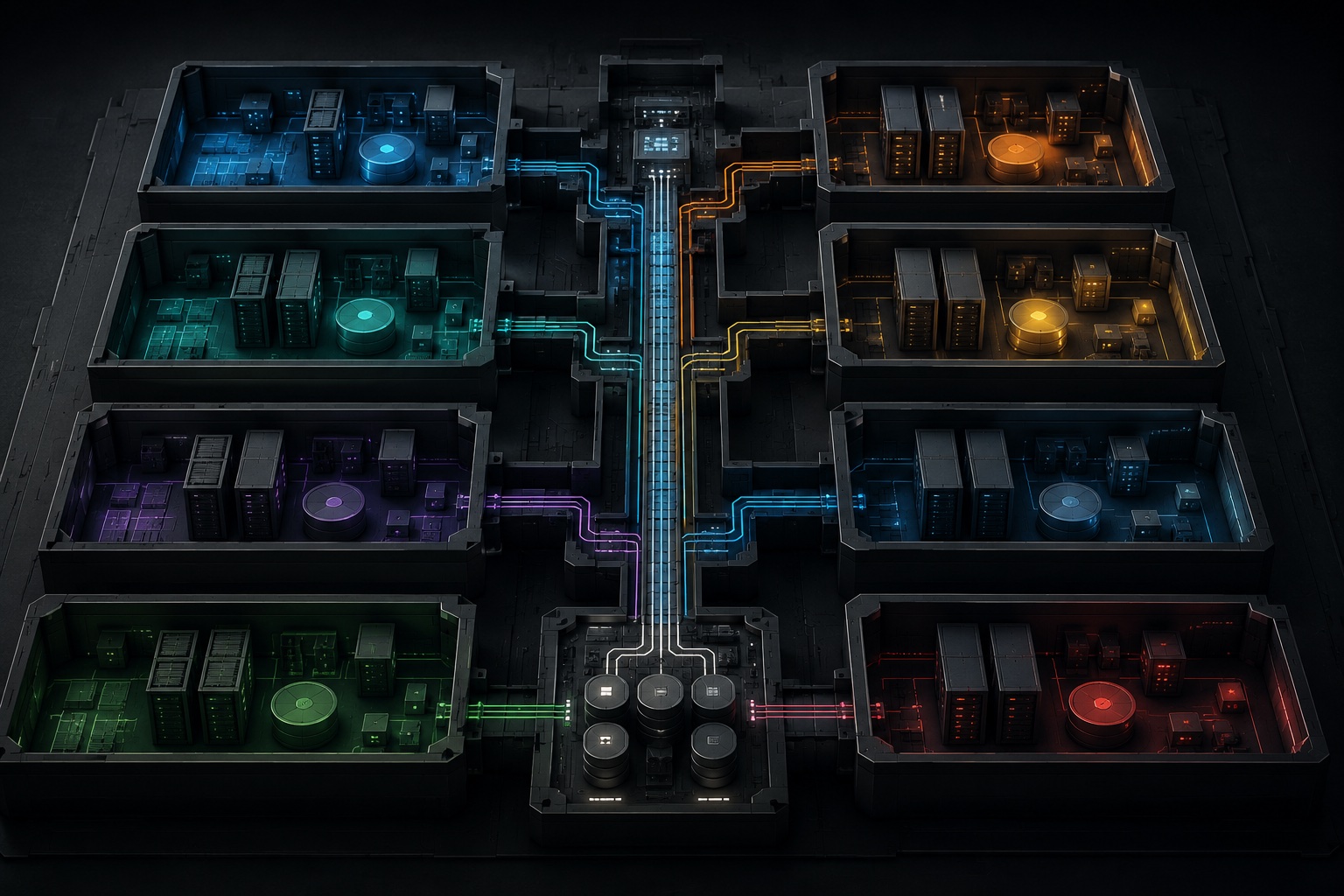
Multi-tenant SaaS architecture is often treated as a technical pattern. Shared infrastructure. Tenant-aware data access. Configurable workflows. Role-based permissions. Scalable deployment. Those things matter, but they do not capture the real weight of the problem.
Multi-tenancy is not just an architecture pattern. It is an operational discipline.
The reason is simple: the platform is never serving one system. It is serving many systems at once, with overlapping infrastructure, shared release paths, uneven usage patterns, and competing expectations around performance, risk, support, and change. A multi-tenant platform is not merely a product delivered to many customers. It is a continuous exercise in managing shared complexity without allowing that shared complexity to become shared fragility.
That is why good multi-tenant design is about more than efficiency. It is about protecting trust.
The shared platform promise
The attraction of multi-tenancy is obvious. A single platform can support many customers, reduce duplication, simplify delivery, and improve operational leverage. Done well, it creates an economic and technical model that is hard to match with isolated per-customer deployments.
But the promise only holds if the platform can stay coherent under pressure.
As the tenant base grows, so do the differences between tenants. Traffic patterns vary. Data volumes diverge. Workflow expectations multiply. Integrations accumulate. Priority customers want guarantees. Long-tail customers still expect reliability. Internal teams begin to rely on the platform's consistency even while making exceptions around it.
At that point, the architecture is no longer being tested by whether it works in principle. It is being tested by whether it can absorb variation without losing control.
That is the real multi-tenant challenge.
Tenant boundaries are not just technical boundaries
It is easy to think of tenancy in terms of row-level separation, account identifiers, or permission checks. Those are necessary, but they are not sufficient.
Tenant boundaries are also business boundaries. They define who can affect whom, which failures are isolated, how support incidents are understood, how upgrades are rolled out, how reporting is interpreted, and how trust is preserved when something goes wrong.
If those boundaries are weak, the platform becomes difficult to reason about. A seemingly local change can create cross-tenant consequences. A performance issue can become a fairness issue. A support problem can turn into a data confidence problem. A configuration shortcut can become a long-term architectural liability.
That is why strong multi-tenant architecture starts with one core question: what must never leak across tenant boundaries?
Data is the obvious answer. But it is not the only answer.
Failure should not leak. Performance noise should not leak. Unsafe assumptions should not leak. Operational shortcuts should not leak. The goal is not merely to separate data. The goal is to contain blast radius.
Isolation is more than separation
People often use the word isolation as though it means physical separation. Separate databases. Separate queues. Separate compute. Those can be good choices, but isolation is really about control.
- Can one tenant's load distort another tenant's experience?
- Can one tenant's custom workflow force platform-wide complexity?
- Can one integration failure cascade into a broader incident?
- Can one customer's urgency disrupt the release discipline required by everyone else?
Those questions matter because a platform can be logically separated and still operationally entangled.
In practice, the best multi-tenant systems use layers of isolation rather than a single mechanism. Data boundaries, workload controls, caching strategy, queue discipline, configuration scoping, deployment safeguards, and observability all contribute to isolation. If one of those layers is weak, the platform may still function, but it becomes harder to trust under scale or stress.
The hardest problems appear during change
A multi-tenant platform often looks stable until it has to change quickly.
That is when the architecture reveals itself.
Adding features is not only a product exercise. It is a tenancy exercise. Does the feature belong to everyone? Can it be selectively enabled? Does it introduce new data coupling? Does it create tenant-specific behavior that will have to be supported forever? Does it complicate upgrade paths or reporting consistency?
The same is true of modernization. The question is not simply whether the platform can be improved. The question is whether it can be improved without destabilizing the tenants who rely on it.
This is where operational discipline matters more than architectural slogans. Release safety, backward compatibility, tenant-aware testing, migration planning, and staged rollout strategy matter because shared platforms concentrate change risk. A failure in a multi-tenant system is rarely just a bug. It is often a trust event.
Observability must be tenant-aware
A platform is difficult to operate if it cannot explain tenant-specific behavior.
Global metrics are not enough. Aggregate health can look fine while a meaningful tenant cohort is having a bad day. Averages hide outliers. Throughput hides friction. System-wide success rates hide degraded experiences affecting the customers who matter most.
Good multi-tenant operations require visibility that follows the same boundaries the business cares about. Tenant-aware logging. Tenant-aware alerting. Tenant-aware performance tracing. Tenant-aware incident diagnosis. Without these, support teams are forced into guesswork and engineering teams lose time distinguishing platform-wide issues from localized ones.
Observability is not just instrumentation. It is a way of preserving architectural clarity under operational pressure.
Standardization is a scaling strategy
One of the quiet truths of multi-tenant SaaS is that standardization is not the enemy of flexibility. It is the condition that makes flexibility survivable.
Without standards, every new tenant-specific demand becomes an architectural negotiation. Every exception adds support burden. Every workflow variation increases the chances of hidden coupling. Over time, the platform stops behaving like a platform and starts behaving like a collection of loosely related accommodations.
That is not scale. That is drift.
The goal is not to eliminate variation. It is to decide where variation belongs. Well-designed configuration, bounded extension points, disciplined domain rules, and consistent operational patterns let a platform remain adaptable without becoming incoherent.
The strongest multi-tenant systems are not the ones that say yes to everything. They are the ones that know where to be flexible and where to remain firm.
Good architecture reduces blast radius
This is the operational core of the whole topic.
Good multi-tenant architecture reduces blast radius.
It reduces the blast radius of bad input. Of unusual load. Of mistaken assumptions. Of deployment mistakes. Of integration instability. Of rushed decisions. Of tenant-specific edge cases. Of organizational pressure.
That is the standard that matters because shared systems are always exposed to more pressure than they appear to be. They carry technical load, customer expectations, support overhead, commercial promises, and internal urgency all at once.
The architecture does not succeed because it is elegant in isolation. It succeeds because it can keep the platform comprehensible and reliable while those forces continue to act on it.
Multi-tenancy is a judgment problem
At a certain scale, multi-tenant architecture becomes less about diagrams and more about judgment.
- What should be shared, and what should be isolated?
- What should be configurable, and what should remain standardized?
- What should be tenant-aware at the application layer, and what should be enforced by infrastructure or data design?
- What deserves optimization, and what simply needs stronger boundaries?
These are not purely technical choices. They shape cost, risk, maintainability, supportability, and trust.
That is why multi-tenant SaaS architecture is ultimately an operational discipline. It is the work of designing a shared platform that can evolve, scale, and remain reliable without collapsing under the weight of its own success.
That is the work.

No comments yet