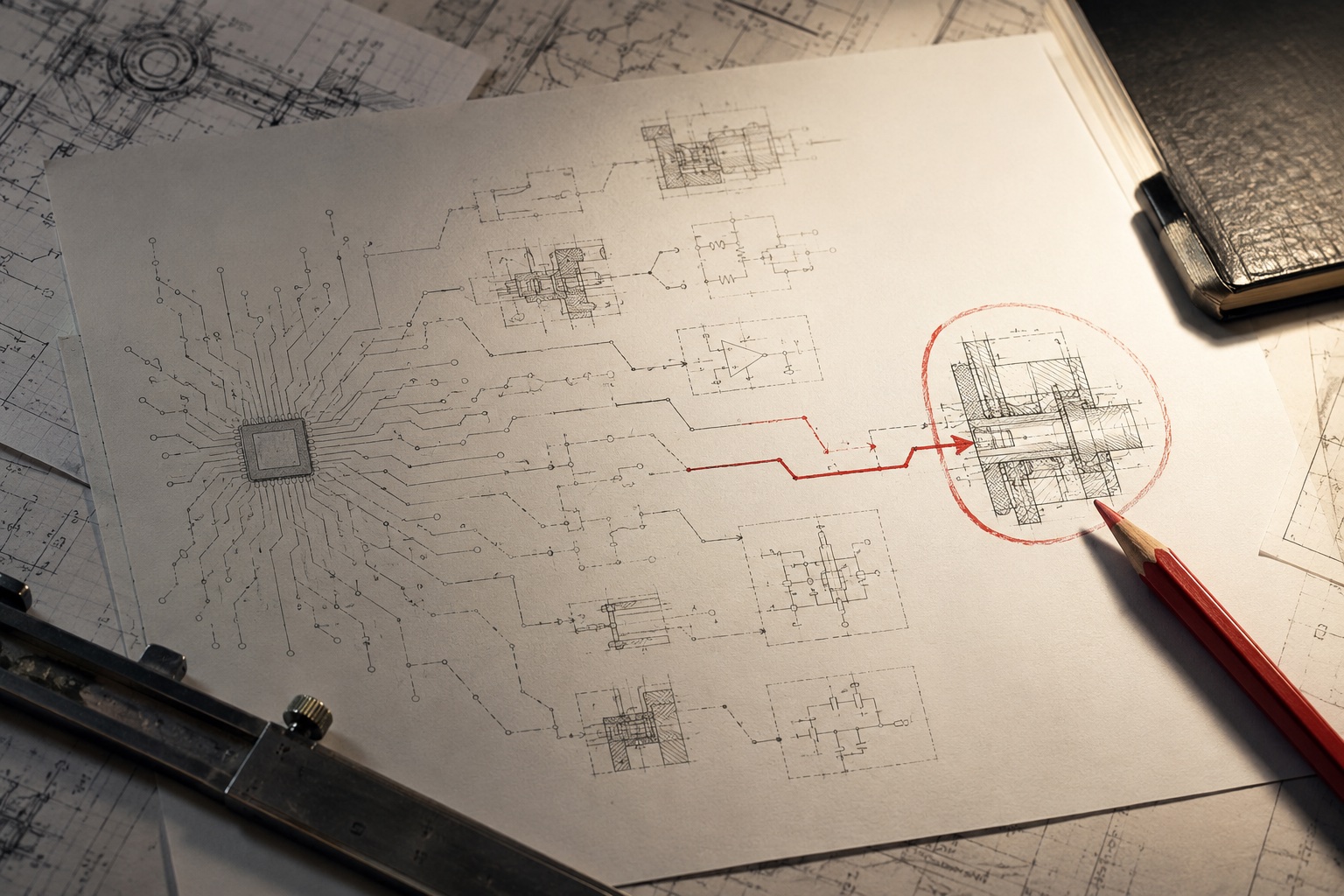
AI is already changing engineering work. That much is obvious. It accelerates drafting, compresses lookup time, lowers the cost of exploration, and gives individual engineers access to a kind of always-available technical assistant. For many tasks, it is already useful. For some, it is remarkable.
But usefulness should not be confused with authority.
AI can make engineering work faster. It does not remove the need for engineering judgment. In many cases, it increases it.
That is because speed changes the shape of risk. When it becomes easier to produce code, design options, migration plans, test scaffolding, or incident hypotheses, the limiting factor is no longer output alone. The limiting factor becomes the ability to decide what is correct, what is safe, what is relevant, and what deserves trust.
That is not a smaller responsibility. It is a larger one.
The real shift is not generation. It is leverage
The most important thing about AI in engineering is not that it generates text or code. It is that it changes the leverage of individual decisions.
A weak assumption can now travel farther, faster. A shallow pattern can now be reproduced across more files. A plausible explanation can now feel sufficient before it has been verified. A migration idea can now sound complete before it has been tested against operational reality.
The same leverage that helps good engineers move faster also helps weak decisions spread more efficiently.
That is why the conversation should not center only on capability. It should center on control.
- What do we trust the model to do?
- What must still be verified by humans?
- What kinds of tasks benefit from acceleration, and which ones become more dangerous when accelerated?
Those are engineering judgment questions, not tooling questions.
AI is strongest where the cost of being approximately right is low
There are many parts of software work where approximation is useful.
Drafting an explanation. Summarizing a file. Suggesting test cases. Producing a first pass on documentation. Exploring possible approaches. Translating between APIs. Generating routine scaffolding. These are places where AI can create real leverage because the human still has room to inspect, reshape, reject, and decide.
The risk rises when approximate output is treated as if it were operational truth.
Architecture is not just pattern matching. Debugging is not just code reading. Incident response is not just explanation generation. Modernization is not just transformation logic. In all of those cases, the central challenge is judgment under constraint. Context matters. Side effects matter. Hidden dependencies matter. Organizational cost matters.
The model may help, but it does not own the consequence.
That remains our job.
The danger is not bad answers. It is premature confidence
People often describe the weakness of AI in terms of hallucination. That is real, but it is not the most important operational risk.
The larger danger is premature confidence.
An answer can be syntactically clean, structurally plausible, and directionally intelligent while still being wrong for the system in front of you. It may ignore release realities, dependency history, tenant boundaries, migration risk, cost of rollback, data semantics, or the support burden carried by the teams who will live with the change.
This is why senior engineering work is so hard to compress into a prompt. The hardest decisions are not isolated technical puzzles. They are technical choices embedded in systems of consequence.
AI can generate options. Judgment decides which option is survivable.
Good engineering still depends on model-building
The best engineers are not just people who know many tools. They are people who build accurate mental models.
They understand where state lives. How requests move. Which boundaries are real. Which abstractions are leaking. Which invariants must hold. Which failures are local and which are systemic. They know how to reason from partial evidence without pretending uncertainty is gone.
That kind of work still matters in an AI-assisted world. In fact, it matters more.
When output becomes abundant, model quality becomes a competitive advantage. The engineer who can see the real structure of the system will use AI better than the engineer who treats it as a substitute for understanding.
The point is not to resist the tool. The point is to remain capable of evaluating what the tool produces.
Judgment is visible in what you refuse to automate
One of the clearest signs of engineering maturity is knowing what should not be delegated blindly.
Not every task benefits from direct AI acceleration. Some tasks require deliberate friction because the reasoning process is part of the quality control.
There are also areas where speed without disciplined review can create more risk than value:
- Security-sensitive changes
- High-risk production migrations
- Tenant-boundary logic
- Financial calculations
- Incident remediation
- Long-lived architectural decisions
That does not mean AI has no role. It means its role should be bounded.
It can summarize. It can surface possibilities. It can help explore edge cases. It can draft implementation ideas. But the final act of commitment should belong to someone who understands the system, the tradeoffs, and the consequences.
That is not anti-AI. That is responsible engineering.
Tooling changes. Accountability does not
A useful way to think about AI is that it changes the interface of work, not the burden of ownership.
The engineer is still accountable for the migration. The architect is still accountable for the boundary decision. The technical lead is still accountable for the release risk. The operator is still accountable for recovery. The organization is still accountable for the systems it chooses to trust.
That is why AI cannot replace engineering judgment. Judgment is what connects technical action to real-world consequence.
A model can suggest a query. It does not own the data corruption. A model can sketch a refactor. It does not own the outage. A model can produce a migration plan. It does not own the rollback path.
Responsibility remains human, which means judgment must remain central.
The better use of AI is not substitution. It is amplification.
The best use of AI in engineering is not pretending the model is the engineer. It is using the model to amplify disciplined engineering behavior.
That means using it to:
- surface alternatives faster
- draft clearer documentation
- reduce repetitive effort
- improve investigation breadth
- accelerate routine implementation work
- expose blind spots worth reviewing
Used that way, AI can make strong teams stronger. It can create more room for deeper thinking by reducing wasted effort on low-leverage work.
But that only happens when teams remain serious about review, validation, architecture, testing, rollback, observability, and operational safety.
Without that discipline, AI does not remove fragility. It scales it.
Engineering judgment becomes more valuable, not less
There is a temptation to interpret AI progress as a sign that deep engineering judgment will matter less over time. I think the opposite is more likely.
As systems become faster to generate and easier to modify, the value of careful judgment goes up. The people who can evaluate tradeoffs, detect hidden risk, separate novelty from substance, and preserve reliability under pressure will matter even more.
That is because the future of software is not just about producing more output. It is about producing systems that still deserve trust after the output has been shipped.
AI changes the work. But judgment still decides what good work is.
That is the standard that matters.


No comments yet